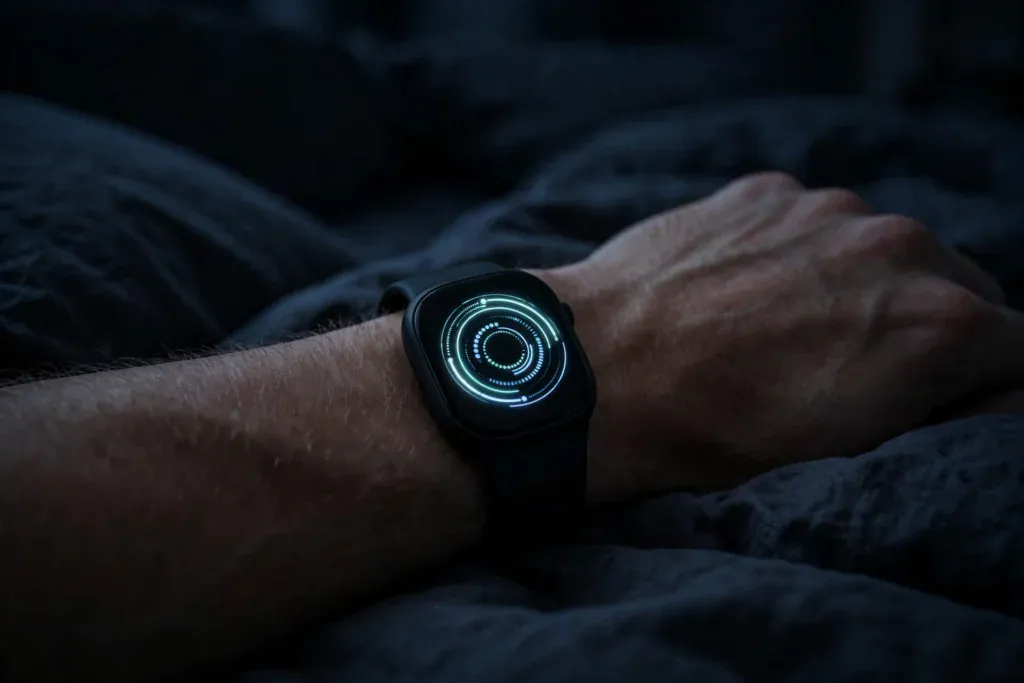
Your wearable gives you a score every morning. Used well, it’s the best feedback tool in your recovery system. Used badly, it’s anxiety with a battery. After years of coaching clients on Oura, Whoop, Garmin, and Apple Watch data, here’s the honest user’s manual.
What wearables get right
Total sleep time and timing consistency — the basics are solid: when you fell asleep, when you woke, and how regular you’ve been. This is the data to trust most, and consistency is the metric that moves everything else.
Resting heart rate and HRV trends — not any single night (noise), but 7–14 day trends are genuinely useful readiness signals: rising resting HR + falling HRV across a week = accumulated stress, under-recovery, illness coming, or life load. That’s actionable.
Respiratory rate and temperature deviation — the early-warning system. Deviations from YOUR baseline flag illness and overreach days before you feel them.
What they get wrong (or oversell)
Sleep stage precision. Wearables estimate stages from movement and heart signals; against lab polysomnography they’re decent at sleep-vs-wake and shaky at exact deep/REM minutes. Treat stage numbers as directional trends, never verdicts. Chasing +12 minutes of “deep sleep” night to night is chasing noise.
The single score. A readiness/sleep score compresses a dozen inputs into one number for engagement, not truth. A “red” score on a morning you feel great is data to note, not a command to skip training. Your subjective readiness (energy, motivation, soreness) is a legitimate input the ring can’t measure.
Orthosomnia — the clinical name for sleep anxiety caused by tracking. If the score is ruining the thing it’s measuring, the protocol is: track trends weekly, ignore daily scores, or take the device off for two weeks and keep the habits.
How athletes should actually use the data
Judge interventions on 2-week trends (matches the night-routine and supplement protocols on this site). Watch the pair: resting HR trend + HRV trend together; either alone misleads. Log the inputs the device can’t see: caffeine time, alcohol, training load, travel — the pattern-matching is your job, the device just keeps score. Use temperature/respiratory deviations as illness radar during heavy blocks and competition prep.
Bottom line
Trust the totals, the timing, and the trends. Doubt the stage precision and never let one morning’s score make your decisions. The wearable is the scoreboard — your protocol is still the game.